


Alex Kostadinov is the heart and soul of AustralianStakes and uses his vast iGaming experience to craft content that is both easy to understand and helps Australian players make better decisions before gambling. He personally writes or fact-checks all articles...
Read Full BioObviously, becoming a good poker player takes a lot of practice, but learning how to play is something most people can do in just a few hours. In this guide, I’ll walk you through everything you need to know, including the different types of poker, hand rankings, rules, betting positions, beginner strategy, common mistakes, and practical tips to improve your poker game.
Poker In a Nutshell
In most casino games, you place a bet, the outcome is determined by luck, and you either win or lose your bet.
When it comes to poker, instead of playing against the house, you’re competing against other players at the table. The casino simply hosts the game and takes a small commission (known as the rake), while every decision you make directly affects your chances of winning. That means skill plays a much bigger role than it does in games like roulette or pokies.
Another common misconception is that poker is all about making the best five-card hand. While that’s certainly one way to win, it’s far from the only one. In many hands, the winning player never even shows their cards because everyone else folds after a well-timed bet or bluff. The most important skill in poker is knowing when to bet, raise, call, or fold – and not the cards you’re holding.
That’s what makes poker such a fascinating game. It combines elements of luck, mathematics, psychology, and strategy in a way that no other casino game does. You calculate probabilities, pay attention to positions, manage your own bankroll, and try to convince your opponents that your hand is stronger (or weaker) than it really is all at once.
And yes, luck does play a role in the short term, but ultimately, skill is the deciding factor in poker in the long term.
Poker Hand Rankings
Before you play your first hand, you’ll need to know which poker hands beat others. Fortunately, the rankings are the same in almost every poker variant, including Texas Hold’em, Omaha, Seven-Card Stud, Casino Hold’em, and Video Poker. Here’s the complete ranking, from strongest to weakest:
| Rank | Hand | Description | Example |
|---|---|---|---|
| 1 | Royal Flush | A, K, Q, J and 10 of the same suit. The strongest possible hand. | A♥ K♥ Q♥ J♥ 10♥ |
| 2 | Straight Flush | Five consecutive cards of the same suit. | 9♣ 8♣ 7♣ 6♣ 5♣ |
| 3 | Four of a Kind | Four cards of the same rank ("Quads"). | A♠ A♥ A♦ A♣ 7♦ |
| 4 | Full House | Three of a kind plus a pair. | K♣ K♦ K♥ 9♠ 9♦ |
| 5 | Flush | Five cards of the same suit, not in sequence. | A♠ J♠ 10♠ 6♠ 2♠ |
| 6 | Straight | Five consecutive cards of mixed suits. | 10♦ 9♠ 8♣ 7♥ 6♠ |
| 7 | Three of a Kind | Three matching cards. | Q♣ Q♦ Q♥ 8♠ 3♦ |
| 8 | Two Pair | Two different pairs. | J♠ J♦ 6♣ 6♥ A♦ |
| 9 | One Pair | Two cards of the same rank. | A♣ A♦ 10♠ 7♥ 4♣ |
| 10 | High Card | No made hand. Highest card wins. | A♠ J♦ 8♣ 5♥ 2♦ |
How to Play Poker (Texas Hold'em Edition)
Now that you know how hand rankings work, it’s time to learn how a game of Texas Hold’em works. Every hand follows the same sequence, so the only difference is your position at the table. Once you’ve played a few hands, the process will become second nature. Here’s how a typical hand unfolds:
Step 1: The Blinds
Every hand of Texas Hold’em starts with two mandatory bets known as the Small Blind and Big Blind. Sometimes you also have to pay an Ante (a small mandatory ‘fee’ that goes in the pot), but the two blinds are present in all Texas Hold’em games.
These forced bets ensure there’s always money in the pot, giving players something to compete for. The player immediately to the left of the dealer button is the Small Blind, while the next player posts the Big Blind, which is usually twice the size of the Small Blind.
For example, in an A$1/A$2 game:
- Small Blind = A$1
- Big Blind = A$2
The dealer button moves one seat clockwise after every hand, meaning everyone takes turns posting the blinds.
Step 2: Every Player Receives Two Hole Cards
Once the blinds have been posted, every player receives two private cards, known as hole cards. Only you can see your hole cards, and they’ll remain hidden from the other players throughout the hand unless you reach the showdown.
At this point, you’ll already begin thinking about the strength of your starting hand. Premium hands like A♠ A♥, K♣ K♦, or A♠ K♠ are usually worth playing aggressively, while weaker hands are often folded before the action even begins, but it all depends on your stack and position at the table.
Step 3: The Pre-Flop Betting Round
After everyone has received their two hole cards, the first betting round begins. Starting with the player to the left of the Big Blind, each player has five possible actions:
- Fold: Give up your hand. If you have any chips invested by that point, you lose them.
- Call: Match the current bet, which is the size of the big blind unless someone raises.
- Raise – Increase the size of the bet. If someone raises, all remaining players must act by either calling or folding.
- Check – Pass the action without betting (only possible if no bet has been made).
- Go All-In – Bet all of your remaining chips.
Once every player has acted, the game moves to the flop.
Step 4: The Flop
The dealer places three community cards face-up in the centre of the table. These cards belong to everyone, meaning every remaining player can use them to make the best possible five-card hand.
Then, another round of betting now takes place, and this is usually when players begin making pairs, draws, or other strong hands.
Step 5: The Turn
After the flop betting round is complete, the dealer reveals a fourth community card, known as the Turn. With six total cards now available (your two hole cards plus four community cards), many hands become much clearer. Players chasing straights or flushes may still have one final chance to improve.
Unless someone raises and every other player holds, another betting round follows. If all but one remaining player decide to fold their hand, the remaining player wins the pot.
Step 6: The River
The fifth and final community card is called the River.
Every remaining player now has access to seven cards in total, including two private cards and five community cards – but only the best five-card combination counts.
A final round of betting takes place before the showdown. Again, if all but one player folds, the remaining player wins the pot before the showdown.
Step 7: The Showdown
If two or more players remain after the final betting round, they reveal their hole cards. The player with the strongest five-card poker hand wins the pot. If two players have exactly the same hand, the pot is split equally between them.
The Different Types of Poker
Poker is not just one game, but a family of card games, each with its own rules, betting structure, and strategy. While the objective is always to build the strongest hand or force your opponents to fold, the rules can be very different.
Over the years, I’ve played almost every major poker variant, from cash games and tournaments to video poker machines and the Casino Hold’em live dealer variant, and I must admit that some take much more time to master than others. Here are the most popular types of poker you’ll find at the best poker sites:
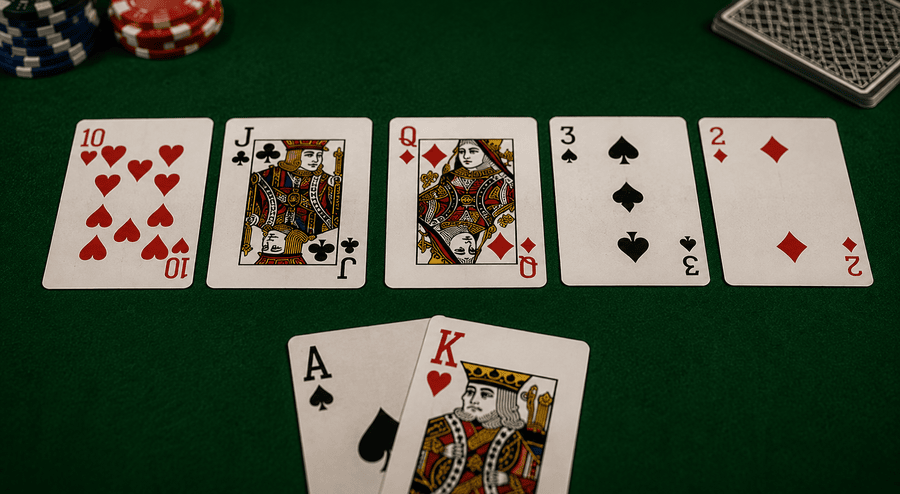
If you’ve ever watched the World Series of Poker or seen poker on TV, you’ve almost certainly been watching Texas Hold’em. It’s the most popular poker game in Australia and around the world, accounting for the vast majority of online poker cash games and tournaments.
Each player receives two private cards, while five community cards are dealt face-up in the middle of the table in three stages. Your goal is to make the best possible five-card hand using any combination of your two hole cards and the community cards.
It’s easy to learn and has endless strategic depth, so it’s the variant I recommend every beginner starts with.

Omaha is very similar to Texas Hold’em, but there’s one major difference: every player receives four hole cards instead of two.
That might sound like it makes the game easier, but it actually creates far more possible hand combinations and much bigger pots. Players must use exactly two of their hole cards and exactly three community cards to make their final hand.
Because strong hands are much more common in Omaha, it’s generally considered a game for more experienced players.
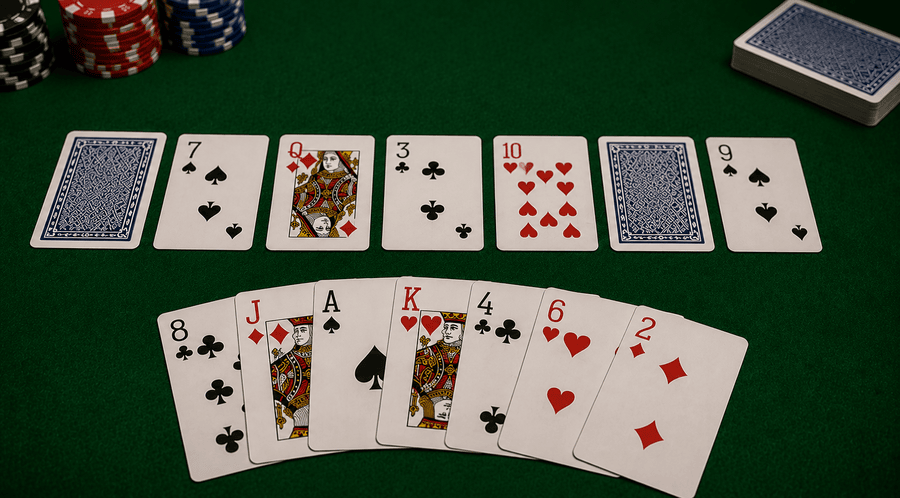
Before Texas Hold’em became the world’s favourite poker game, Seven-Card Stud was the most popular variant in casinos.
Unlike Hold’em, there are no community cards. Instead, players receive a combination of face-up and face-down cards over several betting rounds, eventually making their best five-card hand from the seven cards they’ve been dealt.
While it’s still played today, it’s much less common than Hold’em or Omaha.
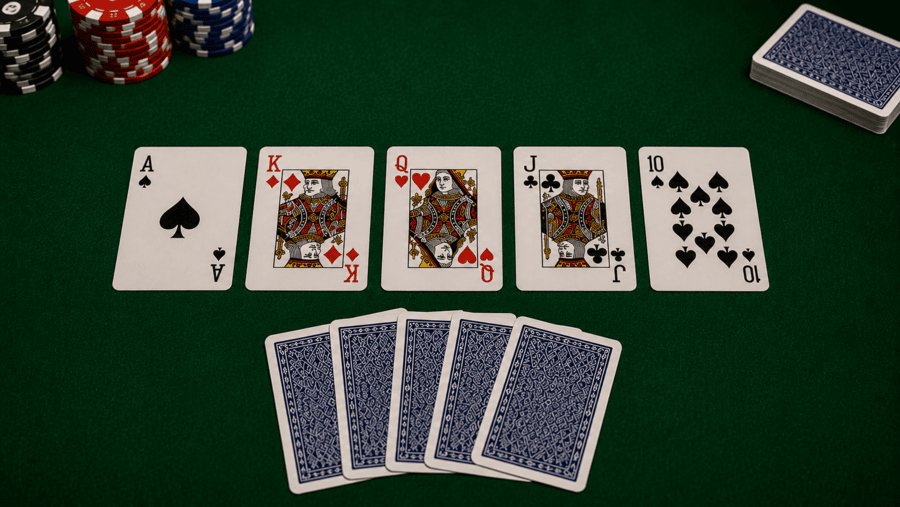
Five-Card Draw is the version most people picture when they think of old Western films or friendly games around the kitchen table.
Each player receives five private cards and has one opportunity to discard unwanted cards in exchange for new ones before the final betting round.
It’s one of the easiest poker variants to learn, although it’s rarely offered at major online poker rooms or casinos.
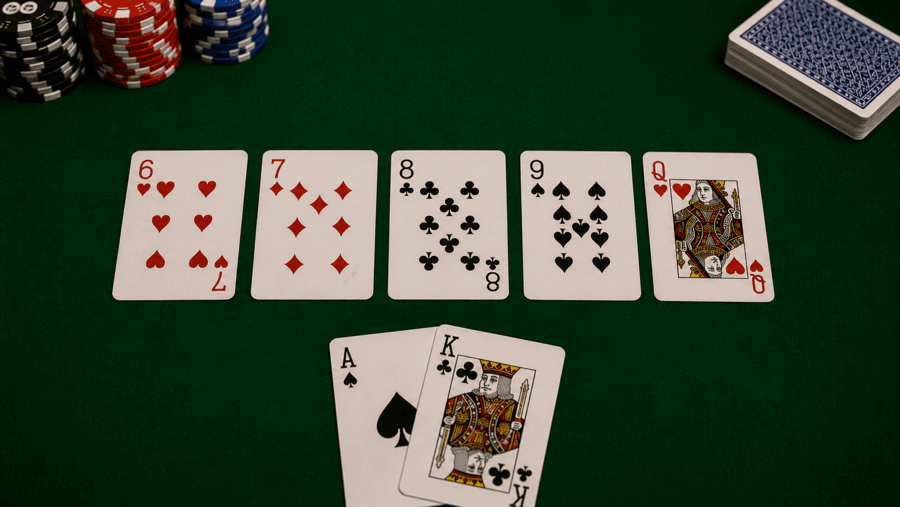
Also known as Six Plus Hold’em, Short Deck Poker uses a reduced deck with the 2s, 3s, 4s, and 5s removed.
With fewer cards in play, players make strong hands much more frequently, leading to bigger action and more aggressive games. It’s become increasingly popular in high-stakes tournaments over the past few years but isn’t usually recommended for complete beginners.

Although it has “poker” in the name, video poker is a completely different game. Instead of competing against other players, you’re playing against a machine. You receive five cards, choose which ones to keep, discard the rest, and receive replacements before being paid according to a fixed payout table.
Success depends entirely on understanding the game’s paytable and using the correct mathematical strategy.
If you’re looking for the traditional poker experience, Texas Hold’em is the way to go. If you simply enjoy making poker hands without competing against other players, video poker can also be a lot of fun.
There are multiple variants, like Three Card Poker, Deuces Wild, Jacks or Better, and similar, and what they all have in common is that they have much higher RTP than most casino games like pokies and are on par with blackjack and baccarat.

Despite the similar name, Casino Hold’em is very different from traditional Texas Hold’em. Instead of competing against other players, you’re playing directly against the dealer, making it feel more like blackjack or baccarat than PVP poker.
The game follows the same hand rankings and uses five community cards, but after receiving your two hole cards, you’ll decide whether to fold or continue by placing an additional bet. To win, your final five-card hand simply needs to beat the dealer’s.
- A Tip From Alex: If you’re completely new to poker, start with Texas Hold’em. Once you’re comfortable with the rules and hand rankings, you can branch out into Omaha, Seven-Card Stud, or Casino Hold’em.
Poker Glossary: Common Poker Terms Every Player Should Know
Like all casino games, poker has its own language, and if you’ve never played before, hearing terms like the flop, check-raise, or the nuts can be confusing. To help you out, I’ve prepared a glossary with the most common poker jargon words that you’ll hear at the poker table and in this and other poker guides by AustralianStakes:
- All-In: Betting all of your remaining chips on a hand.
- Ante: A small forced bet that every player contributes before the hand begins (used in some poker games and tournaments).
- Big Blind (BB): The larger of the two mandatory blind bets posted before the cards are dealt.
- Bluff: Betting or raising with a weak hand to convince your opponents to fold.
- Board: The community cards dealt face-up in the middle of the table.
- Button (Dealer): A marker showing the dealer position. The Button is usually the best position at the table because it acts last after the flop.
- Call: Matching the current bet to stay in the hand.
- Check: Passing the action without betting when no bet has been made.
- Community Cards: The shared cards that every player can use to make their best five-card hand.
- Cutoff (CO): The seat immediately to the right of the Button, considered one of the strongest positions.
- Draw: A hand that isn’t complete yet but can improve with future community cards, such as a flush draw or straight draw.
- Flop: The first three community cards dealt after the opening betting round.
- Fold: Giving up your hand and any chips you’ve already invested in the pot.
- Hole Cards: The two private cards dealt to each player in Texas Hold’em.
- Kicker: An unpaired card used to break ties when players have the same made hand.
- The Nuts: The best possible hand at any given moment.
- Outs: The unseen cards that can improve your hand into a likely winner.
- Pot: The total amount of chips being contested in the current hand.
- Pot Odds: The relationship between the current size of the pot and the cost of calling a bet.
- Pre-Flop: The first betting round before any community cards are dealt.
- Raise: Increasing the current bet.
- Rake: A small fee taken by the casino or poker room for hosting the game.
- River: The fifth and final community card.
- Showdown: The point where the remaining players reveal their cards to determine the winner.
- Small Blind (SB): The smaller of the two mandatory blind bets posted before each hand.
- Tilt: Playing emotionally after a bad beat or losing streak, often leading to poor decisions.
- Turn: The fourth community card dealt after the flop.
- Under the Gun (UTG): The first player to act before the flop, making it one of the toughest positions at the table.
- Value Bet: A bet made with a strong hand in the hope that a weaker hand will call.
Poker Positions Explained
If there’s one lesson I’ve learned after more than 20 years of playing poker, it’s this: where you’re sitting can be more important than the cards you’re holding.
Many beginners focus entirely on their two hole cards, but experienced players pay much more attention to their position at the table. Acting after your opponents gives you more information, making it easier to decide whether to bet, call, raise, or fold.
In general, the later you act in a betting round, the bigger your advantage. These are the three main positions you will find yourself in on a poker table:
Early Position (EP)
Early Position refers to the first players to act after the blinds. In a full-ring game, this usually includes Under the Gun (UTG) and the player immediately after them.
Since you’ll have to make a decision before most other players have acted, this is the riskiest and objectively worst position at the table. You have very little information about what your opponents intend to do, which is why it’s best to play only the very strongest hands.
Middle Position (MP)
Middle Position is after the EP, but before the LP. It gives you a little more flexibility because a few players have already acted before it’s your turn.
You’ll have a better idea of whether the pot is likely to become aggressive or remain relatively passive, allowing you to widen the range of hands you’re willing to play.
Late Position (LP)
Late Position is where you want to be. This includes the Cutoff (the seat immediately to the right of the dealer) and the Button (the dealer position). Because you’ll act after everyone else, you’ll have the most information before making your decision.
Late position is the best position to be in because it allows you to:
- Play a wider range of starting hands
- Bluff more effectively
- Control the size of the pot
- Steal the blinds
- Make better value bets
For these reasons, the Button is widely considered the strongest position at the poker table, so you should use it to your advantage.
The Blinds
Although the Small Blind and Big Blind act last before the flop, they’ll be the first to act on every betting round after the flop. That makes both positions more difficult to play, and I recommend paying close attention when playing on the blinds if you’re a beginner.
Why? Because you’ve already invested chips before seeing your cards, so it can be tempting to play weak hands simply because you’ve “already put money in.” That’s a mistake I’ve made hundreds of times, and I’ve seen every beginner do it – so be very careful when on the blinds because you can easily get carried away and spend more than you should.
Whenever possible, make your decision based on the strength of your hand, and not the chips you’ve already committed.
Basic Poker Strategy for Beginners
Poker is a game of skill, and you need to improve your skill constantly if you want to get better. The basic strategy is only the beginning, and there are many complex strategies you can learn after that, but I suggest you start with these steps and progress from here:
You don’t have to play every hand you’re dealt. Most good players fold far more often than they play, waiting for situations where they have a genuine advantage. If your starting hand isn’t strong enough, simply fold and wait for a better opportunity.
When you decide to enter a pot with a premium hand, don’t be afraid to bet or raise. Playing passively gives your opponents the chance to improve cheaply, while aggressive play puts pressure on them and helps you build the pot when you’re ahead.
The later you act, the more information you’ll have before making your decision. The best strategy is to play tighter from early position, loosen up slightly from late position, and remember that acting last is one of the biggest advantages in poker.
As much as I tell players to bluff more often, you shouldn’t bluff every hand. In fact, as a complete beginner, you’ll usually have better results by betting your strong hands for value and bluffing only in the right situations. Unnecessary bluffs can be expensive, so limit your bluffing and use it only occasionally.
Every poker player loses with great hands from time to time, and this is called a ‘bad beat’. Some poker sites, like Ignition, even offer bad beat bonuses to soften the blow if you lose with a really strong hand.
The biggest mistake you can make is letting one unlucky hand affect your next decision. Chasing losses or playing emotionally, known as tilting, is one of the quickest ways to lose your bankroll.
Bankroll management is crucial when playing poker. Only play with money you can afford to lose, and choose stakes that suit your bankroll. Poker has natural ups and downs, even for experienced players, so sensible bankroll management is essential if you want to keep playing and improving.
Final Thoughts
Poker is easy to learn, but it can take years, or even decades, to truly master.
That shouldn’t put you off, though. In fact, it’s one of the reasons so many people, including myself, fall in love with the game.
There’s always something new to learn, whether it’s refining your strategy, reading opponents more effectively, or improving your decision-making.
For now, focus on the fundamentals. Play good starting hands, make the most of your position, stay patient, and don’t worry about winning every pot. Try not to get tilted and stay consistent, and the results will usually take care of themselves over the long run.
Latest Articles


Gambling is intended only for adults aged 18 and over. AustralianStakes.com is committed to producing fair, independent content, and our editorial opinions are not shaped by casino operators, advertisers, or other outside parties.
Gambling should always be treated as entertainment and contained within sensible limits. Anyone concerned about their own gambling habits or those of a friend or family member can access confidential support through the following organisations:
- https://responsiblewagering.com.au/
- https://www.gamblinghelponline.org.au/
- https://gamblershelp.com.au/get-help/