



What Is a Blackjack Strategy Chart?
A blackjack strategy chart is a quick reference that shows you the mathematically correct move for every possible combination of your hand and the dealer’s upcard.
It covers the four basic options – hit, stand, double down and split – so instead of guessing what to do, you can simply find your situation on the chart and follow the recommendation.
The chart is based on basic blackjack strategy, which uses probability to determine which decision gives you the best expected result. I won’t go into the mathematics behind it here, as you’ll find more info in my blackjack guide. For this guide, the important thing is understanding how to use the finished chart.
Blackjack looks like the simplest game out there, but there are plenty of hands where the obvious move isn’t actually the best one. A strategy chart removes that uncertainty by giving you a decision based on the cards rather than instinct, previous hands, or the feeling that a certain card is “due”.
It’s particularly useful when you’re learning, because you don’t need to memorise the entire basic strategy before playing, and after using the chart regularly, you’ll naturally start remembering the most common situations.
There’s also one thing you need to check before using any chart: the rules of the game. Basic strategy changes depending on factors such as the number of decks, the dealer’s rules on soft 17, whether doubling after splitting is allowed, and the blackjack payout. A chart designed for one set of rules may therefore not be optimal for another, but I’ll get to that later.
Most of the popular online casinos feature dozens of online blackjack games, so it’s worth checking different games before you settle on the best one.
Absolutely not, and that’s the biggest misconception around the basic strategy and the chart. A strategy chart tells you what the best decision is, but it has no influence over which cards are dealt.
You can follow the chart perfectly and lose several hands in a row, just as you can ignore basic strategy and get lucky. The difference is that, over a large enough number of hands, making the mathematically correct decisions gives you the best possible chance and keeps the house edge as low as the rules of the game allow. In the case of classic blackjack, that’s around ~0.5%, with the RTP being up to ~99.5%.
So don’t look at the chart as a way to predict the outcome of a hand. Think of it as a way to make sure your decision is right, regardless of what happens afterwards.
Alex’s tip: Keep the chart next to you when you’re learning rather than worrying about memorising every combination. Most of the common decisions become familiar quickly, and you’ll eventually only need to check it if you’re unsure about a hand.
How to Read the Blackjack Strategy Chart
Before you start using the chart, let me explain which type of hand you’re looking at. Blackjack basic strategy separates hands into three categories: hard hands, soft hands, and pairs, and each category has its own set of recommended plays.
These are the three types of natural hands:
- Hard hands: A hard hand is one where an Ace either isn’t present or can only count as 1 without changing the value of the hand. For example, J + 5 gives you a hard 15.
- Soft hands: A soft hand contains an Ace that can currently count as 11 without making you bust. For example, A + 6 is a soft 17. If you draw a card that would take you over 21, the Ace can switch to 1.
- Pairs: A pair is when your first two cards have the same value, such as 8 + 8 or K + K. These hands are treated separately because you have the option to split them into two hands.
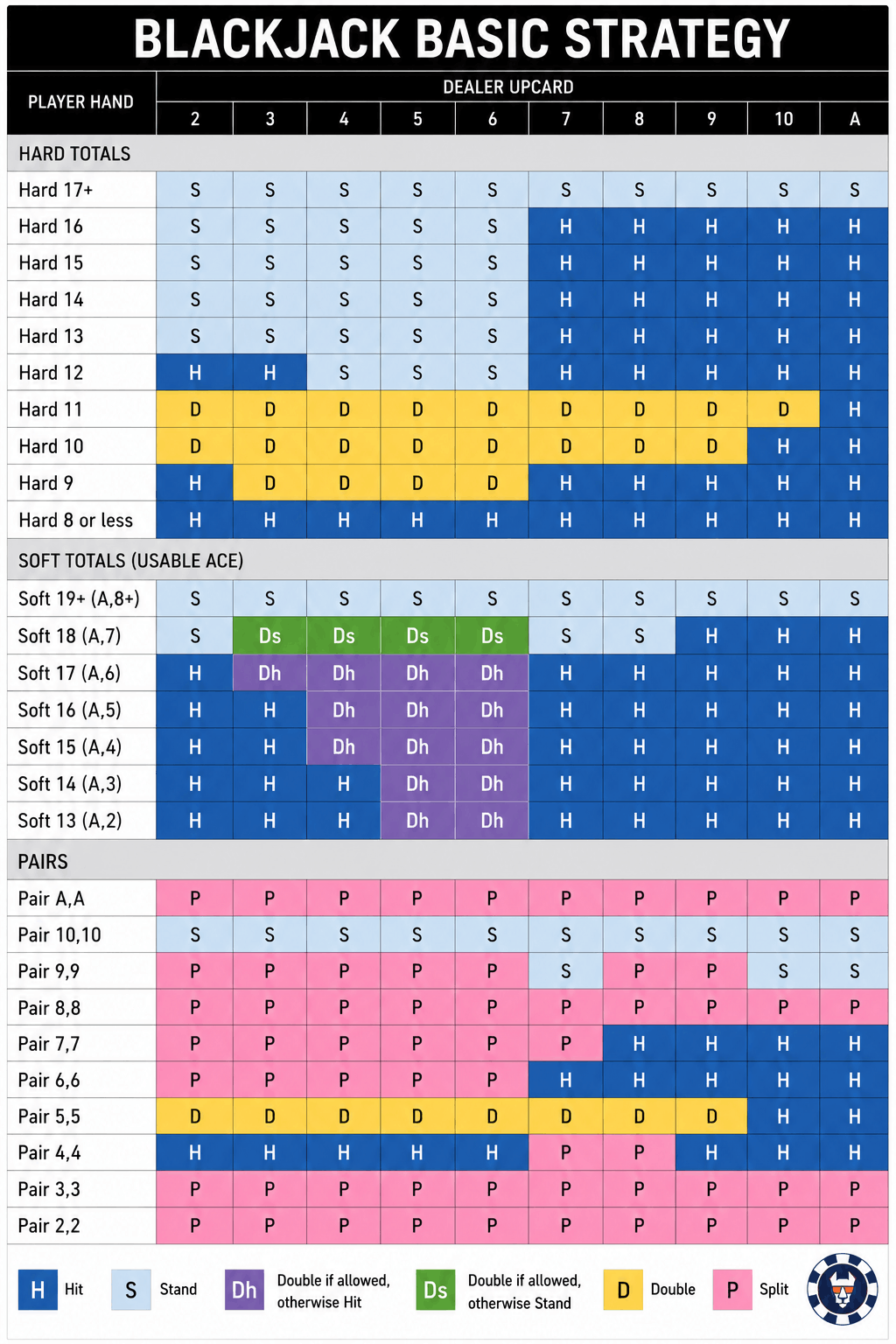
To use the chart, place your hand on the left, find the dealer’s upcard at the top, and the corresponding box will show you the recommended action.
The chart below follows the basic blackjack strategy and is designed to give you the best mathematical decision for each situation in standard blackjack where:
- The dealer stands on soft 17
- Blackjack pays 3:2
- Doubling after splitting is allowed
- The game is played with 6 decks
- You can double on any first two cards
The Right Way to Work Through the Chart
Now, this might seem complicated, but it really isn’t. Once you know what the symbols mean in the chart, the next question is how to use them. Instead of overthinking it, I suggest you follow this path to work through each hand so you always know which move is next according to the basic strategy.
1. Check for Surrender
If surrender is offered at the table, and my tip is to always look for tables with surrender, this is the first option to consider because it is only available at the beginning of the hand. Check your cards against the dealer’s upcard and see whether the chart recommends folding. If it does, surrender, and you’re done. If not, continue to the next option.
2. Look for a Pair
If your first two cards have the same value, check the pairs section of the chart before doing anything else. Some pairs should be split, while others should be kept together or even doubled instead. If splitting is the recommended move, that’s the action you should take.
3. Check Whether You Should Double
If you haven’t surrendered or split, look at the relevant hard or soft hand section and check whether the chart recommends doubling. This is generally used when the maths favours increasing your original bet, but you need to make sure the table actually allows you to double in that situation.
If doubling isn’t available or isn’t recommended, there’s no reason to force it. I strongly suggest against doubling down when the strategy doesn’t say so, because it might lead to losing more money. Instead, you should move on to the final decision.
4. Hit or Stand
At this point, the choice usually comes down to hitting or standing. Find your hand, match it with the dealer’s upcard, and follow the H or S shown in the chart.
The important thing is not to choose your action based on what happened on the previous hand or what you think the next card might be. The most important thing is to follow the chart and only make decisions based on the situation in front of you, not based on intuition or luck.
A Simpler Way to Read Basic Strategy
The full strategy chart can look a little intimidating when you first see it, especially if you’re a beginner and you’re trying to find your hand quickly while playing. To help you out, I’ve broken it down into three separate charts below so you only need to look at the section that applies to the hand you’re holding.
A Tip From Alex: This is what I do: I identify my hand, find the dealer’s upcard, and then follow the recommended action. I suggest you always start with the Hard hands chart if you don’t have a usable Ace, the Soft chart when you have an Ace counting as 11, and the Pairs chart when your first two cards have the same value.
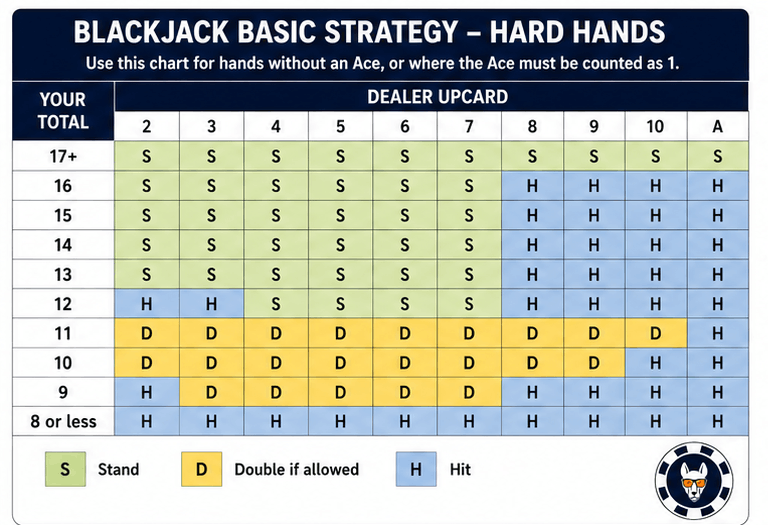
Hard Hands
Hard hands are the most common situations you’ll encounter in blackjack and include hands where there is no Ace or where an Ace has to count as 1. Find your total on the left side of the chart and match it with the dealer’s upcard to see whether you should hit, stand, or double.
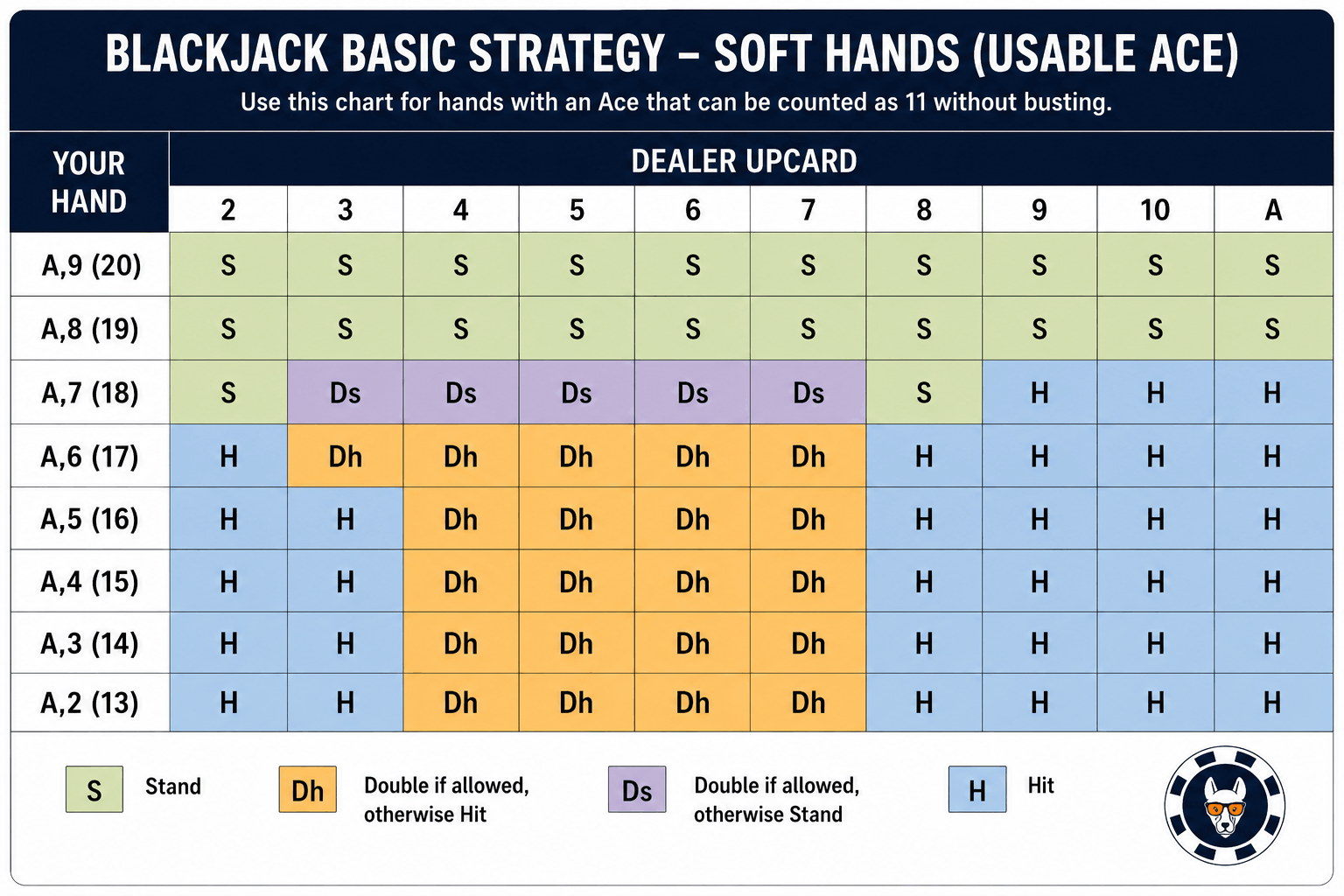
Soft Hands
Soft hands contain an Ace that can still count as 11 without taking your hand over 21. Because the Ace can switch between 11 and 1, these hands give you more flexibility and can sometimes call for a different move than an equivalent hard total.
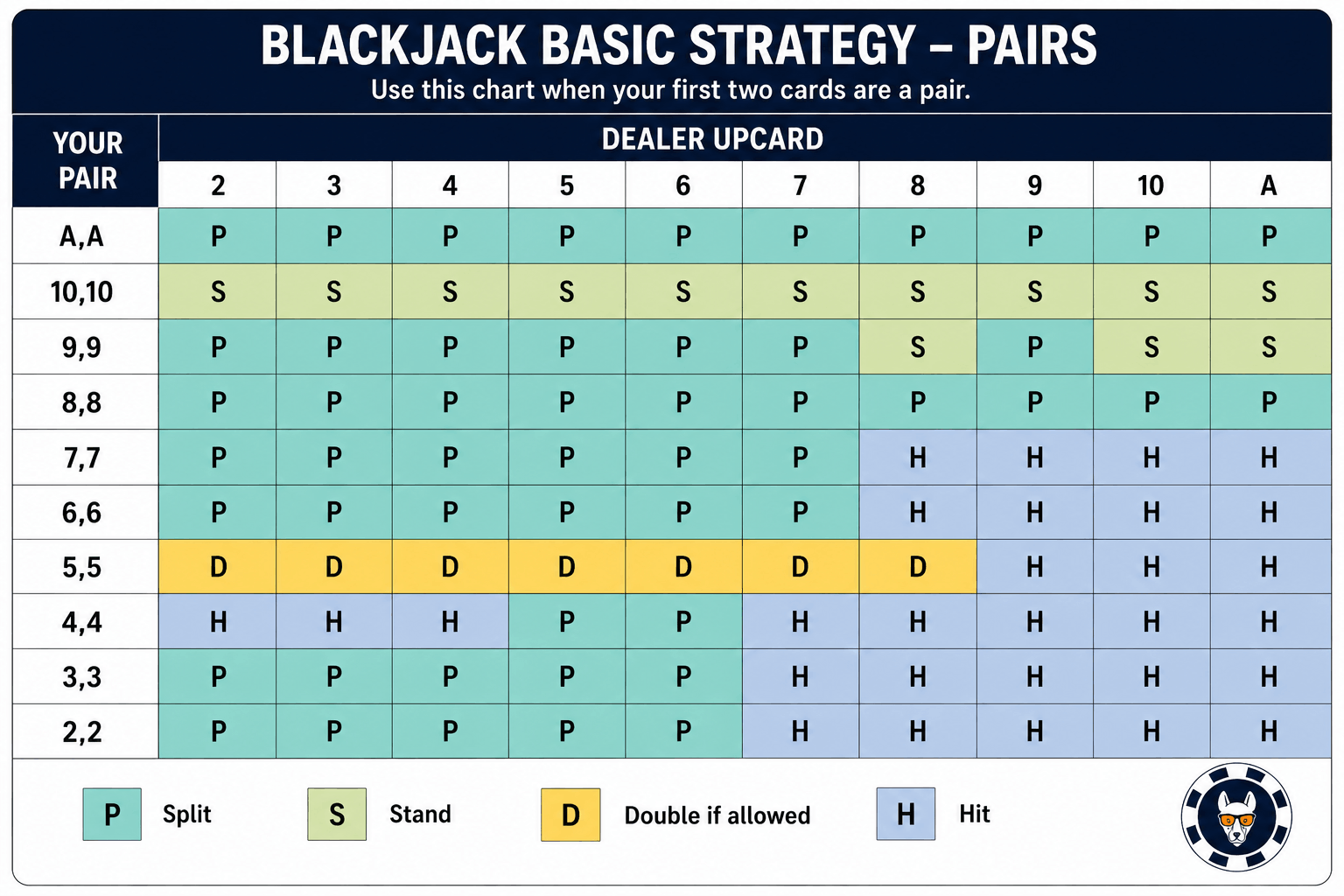
Pairs
Pairs are treated separately because you have the option to split your two cards into separate hands. Find your pair in the left-hand column and then check the dealer’s upcard to see whether the chart recommends splitting, standing, hitting or doubling.
Is Using a Blackjack Strategy Chart Legal?
There’s nothing illegal about knowing the correct way to play blackjack, and nobody is going to arrest you for bringing your own strategy chart to the table.
A strategy chart is simply a reference showing the mathematically optimal decisions for different hands. You’re not using software to interfere with the game, manipulating the cards, or doing anything to the casino’s equipment – you’re simply looking at information and deciding how you want to play your hand.
That said, some land-based casinos can have their own rules about what players are allowed to have on the table, so it’s worth checking before putting a large printed chart next to your chips. If you’re playing at one of the top online blackjack sites, however, you have nothing to worry about, and you can keep the chart open beside the game and use it whenever you’re unsure.
Does Blackjack Strategy Change With Different Rules?
The short answer is: yes, it does. The basic principles stay the same, but the optimal strategy can change depending on the rules of the table. That’s why you should always check the rules before using a strategy chart.
The main things that can affect basic strategy are:
- Dealer hits or stands on soft 17: A dealer can either hit or stand on a soft 17, such as A,6. If the dealer hits, they have another chance to improve their hand, so some of your recommended plays require you to be more aggressive.
- Number of decks: Blackjack can be played with anything from one deck to several decks. The cards are distributed slightly differently depending on the number of decks, which changes the probabilities behind some basic strategy decisions.
- Blackjack payout: A standard blackjack usually pays 3:2, while some tables pay only 6:5. The latter gives the house a larger edge and can also change some of the strategy calculations. My recommendation is to avoid games where blackjack pays 6:5 altogether.
- Doubling restrictions: Some games let you double on any first two cards, while others restrict doubling to certain totals, such as 9-11. If you can’t double in a situation where the strategy recommends it, you need to follow the chart’s alternative action.
- Double after split: Some casinos allow you to double after splitting a pair, while others don’t. Being able to double on your new hands gives you more profitable opportunities and can change the correct play in certain situations.
- Late surrender: Surrender lets you give up your hand after seeing your first two cards and recover half of your original bet. Because you’re accepting a smaller loss instead of playing a weak hand, surrender can be the mathematically best option in a few specific situations, but it’s rarely available nowadays.
Alex’s tip: Always, and I mean always, check the rules of a blackjack game if you’re serious about playing properly. The big differences are usually obvious, such as the notorious 6:5 blackjack payout, but some of the smaller rule changes can be easy to miss, like whether the dealer hits soft 17, whether you can double after splitting, or how many times you’re allowed to resplit a pair.
My Tips on Using the Blackjack Chart
I genuinely recommend using a blackjack strategy chart, whether you’re completely new to blackjack or you’ve been playing for years. It costs you nothing, takes seconds to check, and can help you avoid making decisions that increase the house edge unnecessarily.
You don’t have to become obsessed with memorising every single combination, either. Just keep the chart beside you while you play and use it whenever you’re unsure.
For me, there’s really no downside to using one. If you’re going to play blackjack anyway, why not give yourself every reasonable mathematical advantage available? Obviously, the chart won’t guarantee a winning session, but it does provide genuine value by helping you make better decisions, and that’s more than enough reason to use it.

Gambling is intended only for adults aged 18 and over. AustralianStakes.com is committed to producing fair, independent content, and our editorial opinions are not shaped by casino operators, advertisers, or other outside parties.
Gambling should always be treated as entertainment and contained within sensible limits. Anyone concerned about their own gambling habits or those of a friend or family member can access confidential support through the following organisations:
- https://responsiblewagering.com.au/
- https://www.gamblinghelponline.org.au/
- https://gamblershelp.com.au/get-help/