



What's Basic Blackjack Strategy?
Don’t let the word “basic” fool you. The basic blackjack strategy covers pretty much every situation you’ll come across at blackjack tables at top Australian casinos, so it’s not really basic. The name actually comes from the fact that it’s easy to follow, even for beginners.
Whether you’re holding a hard 16 against a dealer’s 10, have a pair of 8s to split, or need to decide what to do with a soft 18, there’s a mathematically correct move for each situation.
It might look complicated when you first see a blackjack strategy chart, but the idea behind it is quite simple. You look at your cards, check the dealer’s upcard and follow the recommended move. These decisions have been worked out using probability, so you’re not relying on gut feeling or guessing what might happen next.
As I explain in detail in my Blackjack 101 guide, if you follow the basic blackjack strategy to the dot (provided you play a standard blackjack game), the maximum RTP you can get is close to 99.5%.
Once you understand basic strategy, you have everything you need to make the best possible decisions during a game. While it cannot guarantee a win, it will help you keep the house edge as low as the rules allow.
When to Hit in Blackjack
Hitting means asking the dealer for another card, and you should do this when your current hand is unlikely to beat the dealer’s hand and taking another card gives you a better chance of improving it. The decision depends on whether you have a hard or soft hand, and what card the dealer is showing.
First, let’s define what a hard and what a soft hand is:
- Hard hand: A hand without an ace, or one where the ace must count as 1 to avoid going bust. For example, 10 + 7 is a hard 17.
- Soft hand: A hand containing an ace that can count as either 1 or 11 without going bust. For example, an ace + 6 is a soft 17.
Here are some common situations where hitting is the recommended move, according to the basic blackjack strategy, which the blackjack strategy chart is also based on:
- Hard 8 or lower: Always hit, as you can’t go bust with one additional card.
- Hard 12 against a dealer’s 7 or higher: Hit because standing is unlikely to beat the dealer’s hand.
- Hard 16 against a dealer’s 7, 8, 9, 10 or ace: Hit if surrender isn’t available.
- Soft 17 against a dealer’s 7 or higher: Hit to improve your hand without immediately risking a bust.
For example, if you have a hard 12 and the dealer shows a 10, the best strategy is to hit. You could go bust, but standing on 12 against such a strong dealer card is unlikely to end well either.
When to Stand
Standing in blackjack means keeping your current hand and asking for no more cards. You’ll usually do this when your total is good enough or when the dealer is showing a weak card and has a decent chance of going bust.
These are the rules on when to stand, depending on the cards you have:
- Hard 17 or higher: Stand.
- Hard 13-16 against a dealer’s 2-6: Stand.
- Hard 12 against a dealer’s 4-6: Stand.
- Soft 19 or higher: Stand.
The dealer’s upcard is particularly important here. For example, the dealer showing cards like 4, 5 and 6 are considered weak because the dealer has a higher chance of going bust while trying to reach at least 17.
Let’s say that you have a hard 13 and the dealer shows a 5. In this situation, the blackjack strategy says that you should stand because there’s no need to risk going bust when the dealer could easily lose the hand themselves.
However, if the dealer shows a 10, you should hit the same 13 because there’s a good chance they’ll draw another high card, so you need a better total to compete.
When to Double Down
Doubling down in blackjack allows you to double your original bet in exchange for receiving just one more card. It’s a useful move when you have a good opportunity to improve your hand, particularly when the dealer is showing a weaker card.
Basic strategy generally recommends doubling in these situations:
- Hard 9: Double against a dealer’s 3-6.
- Hard 10: Double against a dealer’s 2-9.
- Hard 11: Usually double against a dealer’s 2-10. The exact recommendation against an ace depends on the table rules.
- Soft 16-18: Doubling can be the best move against certain weak dealer cards, depending on the specific hand and rules.
For example, if you have a hard 11 and the dealer shows a 6, doubling down is usually the best move. You have a good chance of drawing a 10-value card and finishing with 21, while the dealer is starting from a weak position.
If doubling isn’t allowed or isn’t recommended for your hand, you can simply hit instead.
When to Split Pairs
If your first two cards have the same value (like two 8s, for example), you can split them into two separate hands. Just note that you’ll need to place an additional bet equal to your original wager, which means that each card becomes the starting point for a new hand.
Some pairs are almost always worth splitting, while others are better left together.
Pairs you should generally split are:
- Aces: Two separate hands give you a better chance of building strong totals than keeping a pair of aces together.
- 8s: Splitting helps you avoid playing a hard 16, which is one of the worst starting hands in blackjack.
- 9s: Usually split against a dealer’s 2-6, 8 or 9, but stand against a 7, 10 or ace.
Pairs you should generally keep together are:
- 10s: A total of 20 is already an excellent hand, so splitting makes no sense.
- 5s: Play them as a hard 10 instead. You may even have an opportunity to double down.
- 4s: Generally don’t split unless the dealer shows a 5 or 6 and the rules allow doubling after splitting.
For example, if you have two 8s and the dealer shows a 10, basic strategy still recommends splitting. It might seem strange to put more money on the table against a strong dealer card, but playing a hard 16 is statistically worse in the long run.
When to Surrender
Surrender is an option that some variants at top blackjack casinos offer, and it lets you give up your hand and recover half of your original bet. You lose the other half, but avoid risking the entire wager on a hand where the odds are particularly poor.
There are two types of surrender:
- Early surrender: You can give up your hand before the dealer checks for blackjack. This is less common, and you’ll rarely use it.
- Late surrender: You can surrender after the dealer checks and confirms they don’t have blackjack. This is the version you’ll usually come across.
Some common surrender situations include:
- Hard 16 against a dealer’s 9, 10 or ace: Surrender is generally recommended when late surrender is available, although there are exceptions depending on the cards making up your 16.
- Hard 15 against a dealer’s 10: Surrender is usually the best option under common multi-deck rules.
For example, if you have a hard 16 against a dealer’s 10, surrendering is often better than playing the hand. You give up half your bet, but you avoid risking the full amount in a situation where you’re statistically at a major disadvantage.
However, not every blackjack game offers this option, so check the table rules before you start playing. If the option isn’t available, follow the normal hit or stand recommendation instead.
Basic Blackjack Strategy Examples
Now that you know what the basic blackjack strategy is and what it stands for, let’s see how it works in practice. I’ll cover 4 common situations where you can see what the basic blackjack strategy recommends, why that move makes sense, and how the dealer’s upcard affects the decision.
Example 1: Hard 16 Against a Dealer's 10
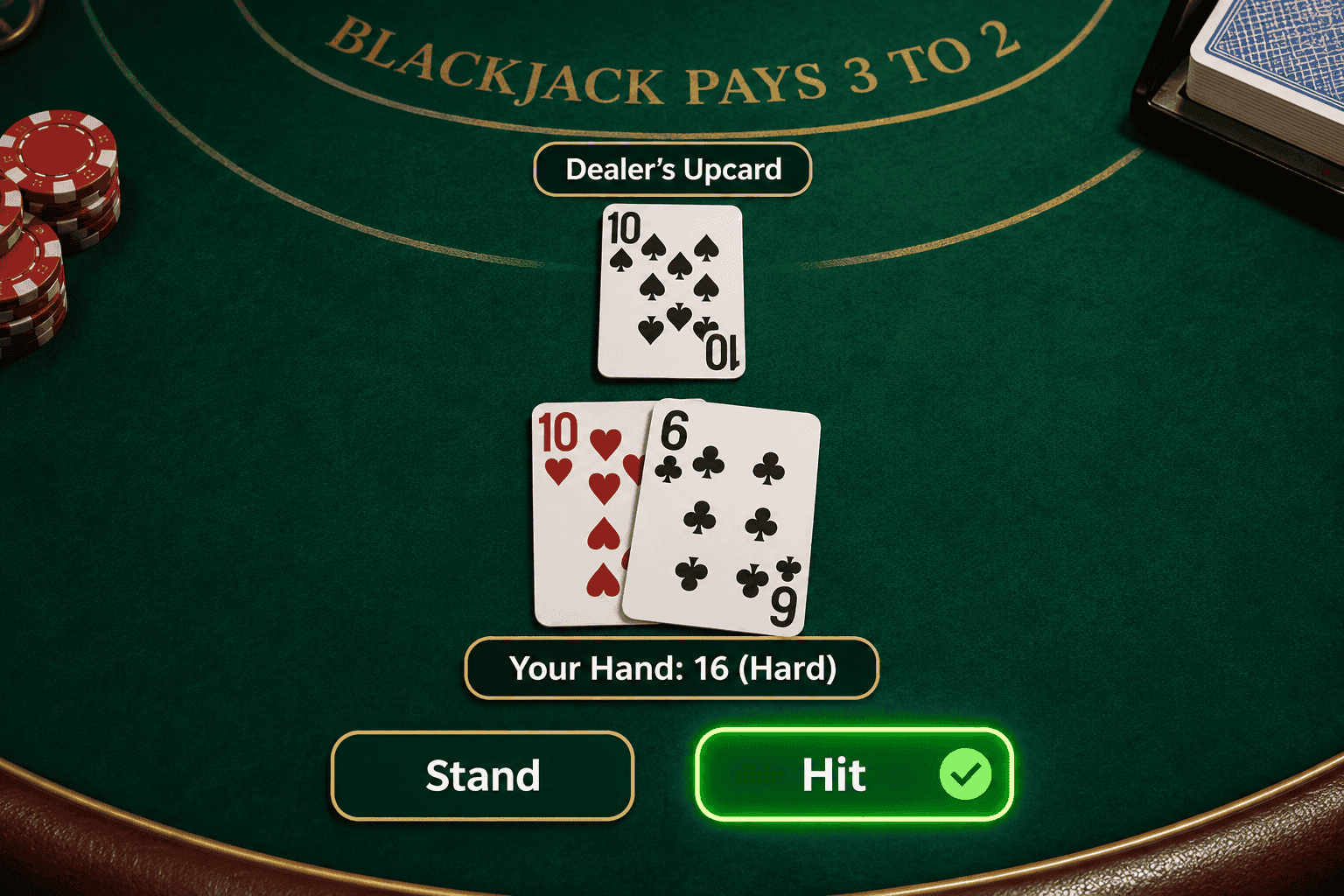
Imagine you’re dealt a 10 and a 6, giving you a hard 16. The dealer has a 10 showing, so it’s not exactly the hand you want.
You have two main options: hit or stand. Standing means keeping your 16, but the dealer has a good chance of finishing with a higher total. Hitting is risky because any card worth 6 or more will make you bust.
Despite that risk, basic strategy recommends hitting if surrender isn’t available. You need to improve your hand because standing on 16 against a dealer’s 10 is unlikely to win. It’s definitely not a comfortable decision, but it’s the mathematically better one in this situation.
Example 2: Hard 11 Against a Dealer's 6
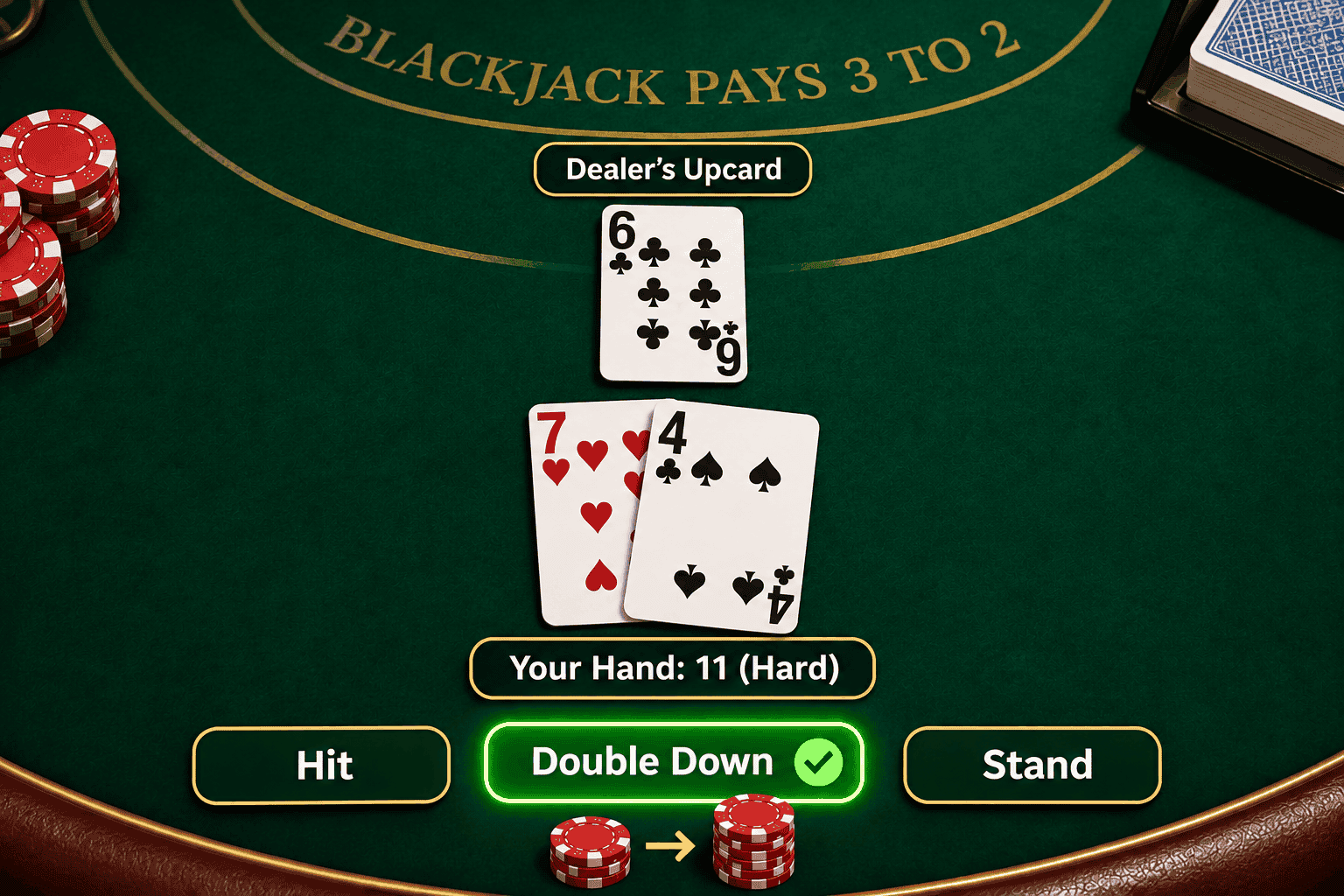
Now, this is a much better situation. Let’s say that you have a 7 and a 4, giving you 11, while the dealer is showing a 6.
Basic strategy recommends doubling down. You double your original bet and receive just one more card in the hope of finishing with a high total. Any 10-value card gives you 21, while an ace, 9 or 8 also leaves you with a very competitive hand.
The dealer’s 6 is another reason to like this move. It’s a weak upcard, and the dealer has a higher chance of going bust. So, the best option here is to double down. You can just hit, but you’re potentially missing an opportunity when the odds are in your favour.
Example 3: A Pair of 8s Against a Dealer's 9
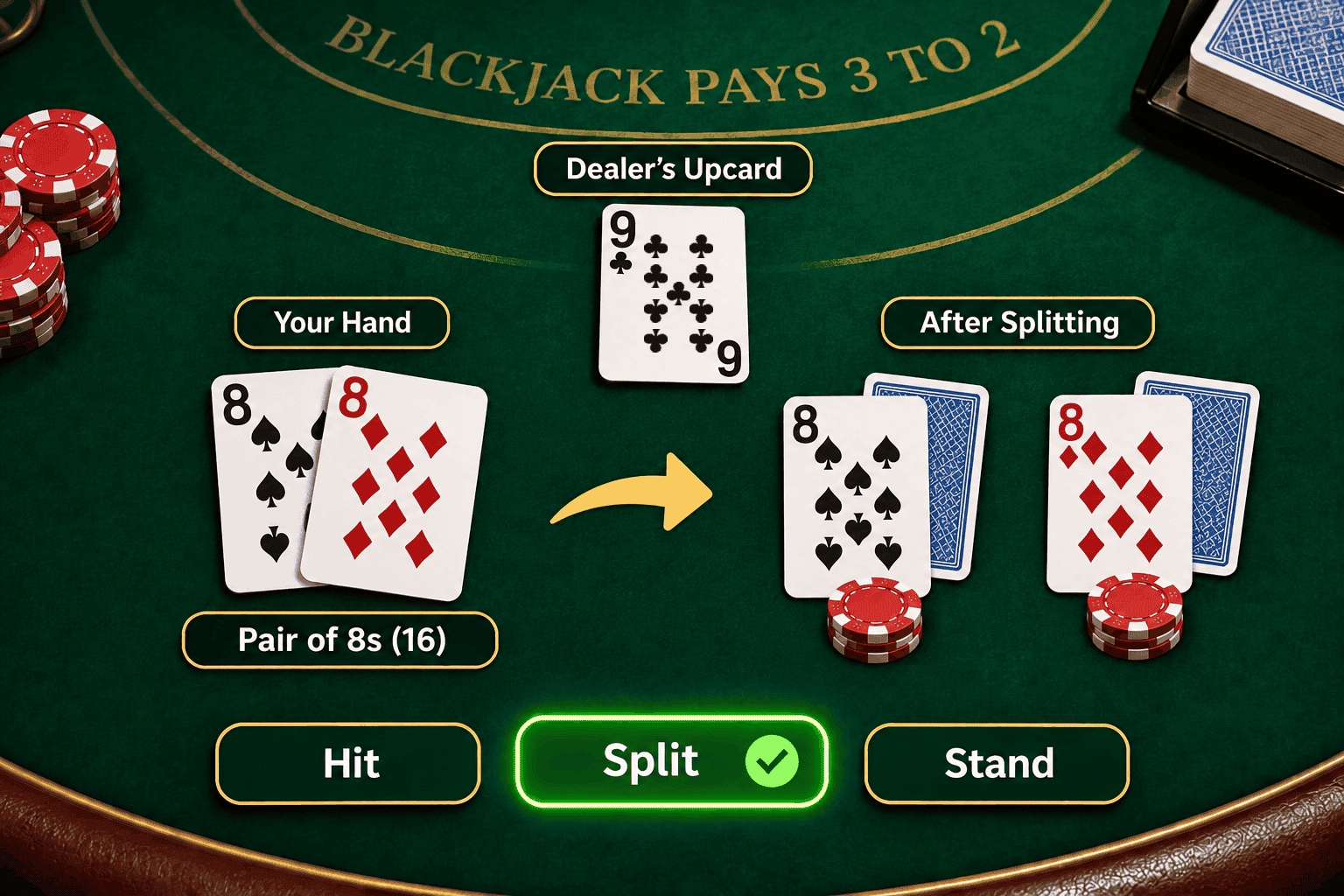
You’re dealt two 8s, giving you a total of 16, while the dealer shows a 9. You could keep the pair and play it as a hard 16, but basic strategy recommends splitting this pair.
By splitting, you turn one difficult hand into two separate hands, each starting with an 8. You’ll need to place another bet equal to your original wager, but you now have two opportunities to build a better total.
Note from Alex: Although the strategy suggests it, I’d like to point out that splitting doesn’t guarantee a better result. Obviously, you could still lose both hands. However, playing a pair of 8s separately gives you better mathematical odds than keeping the hard 16.
Example 4: Soft 18 Against a Dealer's 9
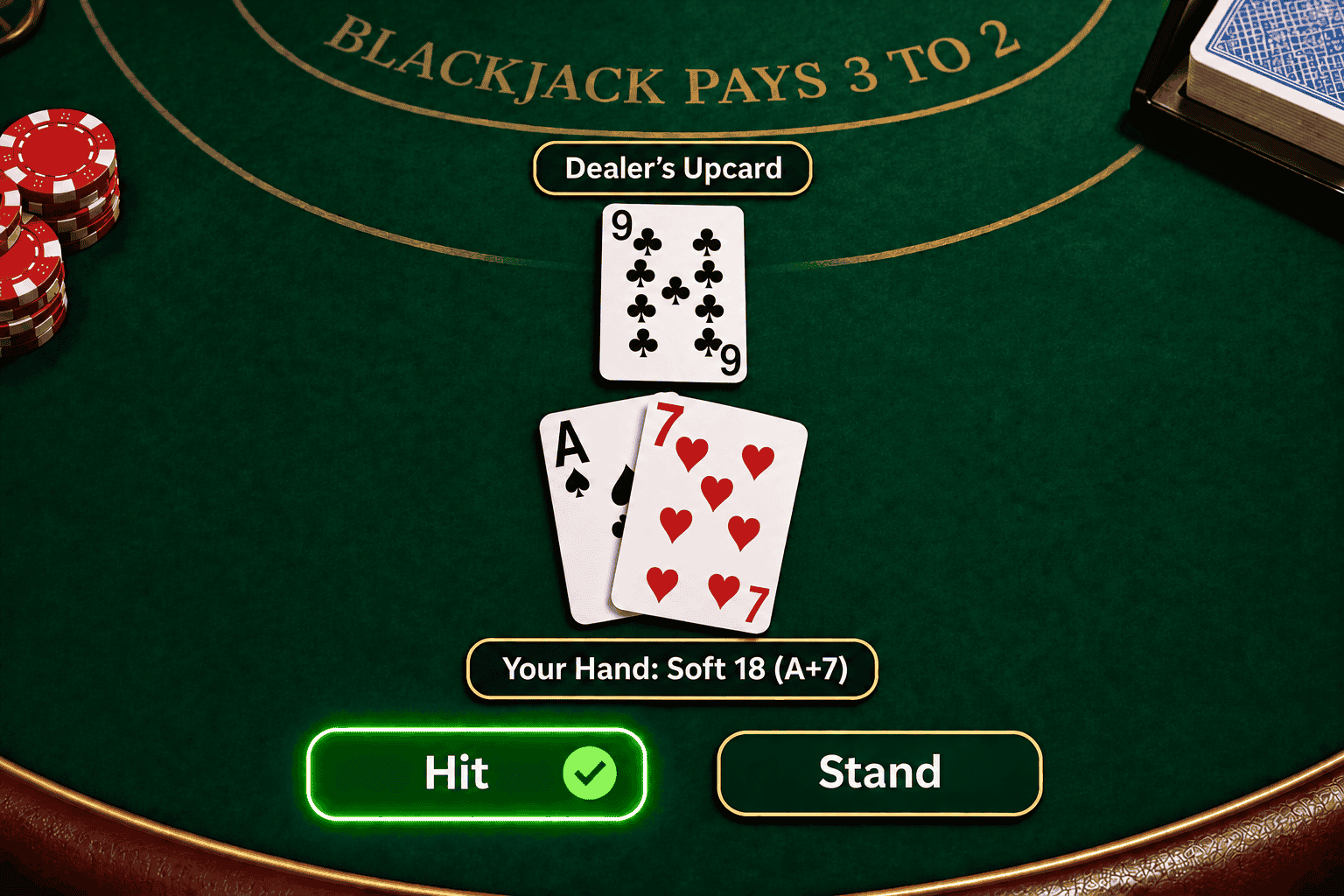
You have an ace and a 7, giving you soft 18. The dealer is showing a 9. At first, standing might seem like the obvious choice because 18 is a respectable total. However, basic strategy recommends hitting.
The reason is that your ace gives you some flexibility. If you draw a 2, 3 or 4, you can improve your hand to 20, 21 or 12 without immediately going bust. However, even if you draw a 10-value card, your ace simply counts as 1, leaving you with a hard 18.
The dealer’s 9 is a relatively strong upcard, so standing on 18 isn’t likely to be enough. Hitting gives you a better chance of improving your hand, and the ace provides a little extra room to take that risk.
Other Blackjack Strategies and Betting Systems
While the basic blackjack strategy is the foundation, it’s not the only approach you’ll hear blackjack players talk about. There are many different approaches and techniques, like getting an advantage by tracking cards or betting systems that tell you how much to wager after a win or loss.
Here’s a look at some of the more common ones.
Card Counting
Card counting is probably the best-known blackjack strategy outside basic strategy. It involves keeping track of the cards that have already been dealt to estimate whether the remaining deck is favourable to the player or the dealer.
The most popular system is called Hi-Lo. You assign values to cards as follows:
- Cards 2-6: +1
- Cards 7-9: 0
- Cards 10, J, Q, K and A: -1
You keep a running count as the cards are dealt, where a higher positive count suggests that more high-value cards remain in the deck, which can be favourable to the player. In that situation, a card counter may increase their bets and sometimes adjust their playing decisions.
For example, if several low cards have already been dealt, more 10-value cards and aces may remain in the shoe. This can improve the player’s chances of getting blackjack and make certain dealer outcomes less favourable.
Card counting takes a lot of practice and concentration, and it’s much harder to do in games using continuous shuffling machines or frequent deck reshuffles.
Alex’s Two Cents: Although card counting has been presented as a ‘sure way’ to win in Hollywood movies, in reality, it’s a rather complex strategy that doesn’t guarantee a win.
Martingale Betting System
Unlike basic strategy, Martingale doesn’t tell you whether to hit, stand or double down. It’s a betting system based on increasing your wager after every loss.
The idea is to double your previous bet until you eventually win. That one win should recover your earlier losses and leave you with a profit equal to your original wager.
For example, imagine you start with an A$10 bet:
- First hand: Lose A$10. The next bet would be A$20.
- Second hand: Lose A$20. The next bet would be A$40.
- Third hand: Lose A$40. The next bet would be A$80.
- Fourth hand: Win A$80. You recover A$70 of your losses and win a profit of A$10.
Well, if it’s so simple, how come people don’t make millions with it? You guessed it – there’s a catch. A few consecutive losses will quickly push your required bet beyond your budget or the casino’s table limits, so it’s a very risky strategy that rarely pays off.
Fibonacci Betting System
The Fibonacci system is another betting progression, but instead of doubling your wager after every loss, you follow a sequence of numbers.
The sequence starts with 1, 1, 2, 3, 5, 8, 13 and continues by adding the previous two numbers together. You move forward in the sequence after a loss and move back two places after a win.
For example, if your base bet is A$10, your wagers would follow this pattern:
- A$10
- A$10
- A$20
- A$30
- A$50
- A$80
This system also increases your bets, but it does so at a slower pace than the Martingale, so it’s a bit less risky, but it still carries the same underlying problem. A long losing streak can become expensive, and following the sequence doesn’t improve your chances of winning.
Shuffle Tracking
Shuffle tracking is a more advanced strategy used by some experienced blackjack players. It involves following groups of cards through the shuffle to estimate where certain cards might end up when the next shoe is dealt.
The goal is to identify sections of the shoe that may contain a higher concentration of favourable cards, particularly 10-value cards and aces.
For example, if you can track a group of high-value cards through the shuffle, you may be able to estimate when those cards are more likely to appear and adjust your betting accordingly.
This is a very advanced strategy that’s considerably harder than card counting and requires a specific type of shuffle that allows cards to be tracked. Most modern casino procedures make this technique difficult to execute or even impossible, so I don’t recommend trying it.
Which Blackjack Strategy Should You Use?
If you’re new to blackjack, my advice is simple: start with basic blackjack strategy and get comfortable using it. You don’t need complicated betting systems or advanced techniques to benefit from blackjack’s high RTP.
Learn when to hit, stand, double down and split, and keep a strategy chart nearby until you know the most common situations by heart. Card counting and other techniques might be interesting to explore later, but basic strategy should always come first.
Just remember that no strategy can guarantee a win or eliminate the house edge. The goal is to have fun while making the best possible decisions, avoid unnecessary mistakes and give yourself the best mathematical chance in the game.
Latest Articles


Gambling is intended only for adults aged 18 and over. AustralianStakes.com is committed to producing fair, independent content, and our editorial opinions are not shaped by casino operators, advertisers, or other outside parties.
Gambling should always be treated as entertainment and contained within sensible limits. Anyone concerned about their own gambling habits or those of a friend or family member can access confidential support through the following organisations:
- https://responsiblewagering.com.au/
- https://www.gamblinghelponline.org.au/
- https://gamblershelp.com.au/get-help/