



How Is Craps Different from Other Casino Games?
Craps is a casino dice game played with two six-sided dice, with players betting on the outcome of the rolls. The modern game developed from Hazard, an older English dice game played as early as the 14th century.
Hazard was eventually simplified and made its way to the United States with the early English settlers, where it became particularly popular in New Orleans during the 19th century.
The name craps is believed to have developed from crapaud, a French term that literally means street dice games. So, craps was never really a casino game, but a street game where two people are willing to bet against each other on the outcome of the two dice.
Craps eventually made the jump from informal street dice games to casinos, where the rules and betting options were standardised by Las Vegas casinos.
The casino version introduced the craps table we know and the game that you can play at many top Australian casinos, with its Pass Line, Don’t Pass, Come, Place and other bets.
In the game, a dealer or stickman manages the dice and betting layout, while one player becomes the Shooter and rolls the dice. The basic idea is this: two dice are rolled, and players bet on what will happen.
The biggest difference is that you’re not really playing against the casino in the same way as you do when playing blackjack or baccarat. One player rolls the dice, while everyone else at the table can bet on the outcome of the two dice.
If you’re the Shooter, you’re not competing against the other players either. They can actually have money riding on your roll, so a lucky throw can make several people at the table happy at once. The casino is still the house and has an edge on certain bets, but the dice are in the player’s hands, and players can bet on all the outcomes.
There’s also more than one roll. The first roll is called the come-out roll, and if a point is established, the Shooter keeps rolling until they either hit that point again or roll a 7. So unlike roulette, where the ball lands and the spin is over, a craps round can continue through several rolls.
That’s also why the game can seem confusing and complicated at first, so I’ll explain how to play it in detail in the next section.
How to Play Craps?
Now that you know a little about where craps came from and what makes it different from other table games, let’s get into the actual game. I’ll walk you through a typical round step by step, from your first bet to the point being hit or the round ending.
1. Place Your First Bet
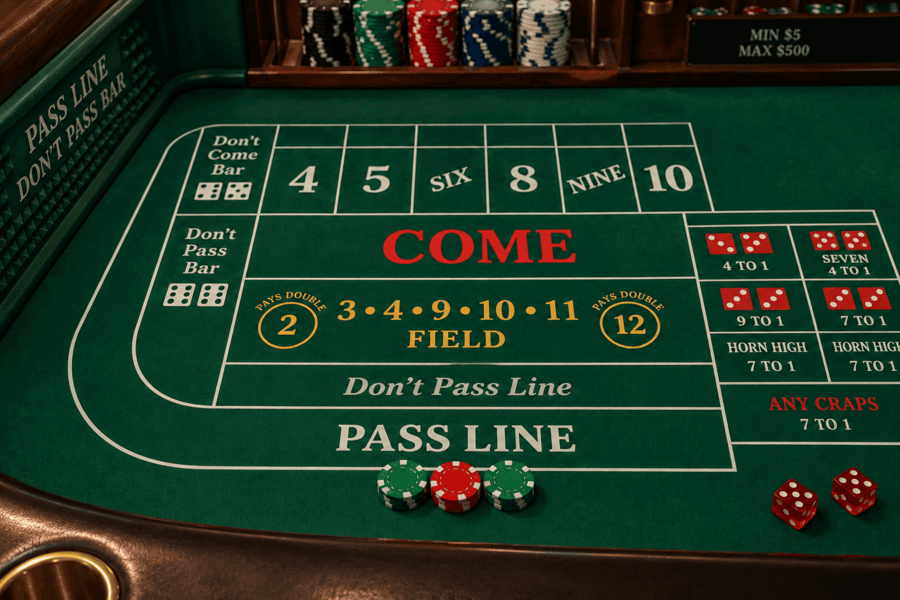
A craps round starts with a come-out roll, but before the dice are rolled, players place their opening bets. If you’re new to the game, the Pass Line is the easiest place to start, and the one I recommend.
You put your chips on the Pass Line area of the table and wait for the Shooter to roll. You don’t have to be the one throwing the dice to place this bet, since you can bet on another player’s roll.
For example, let’s say you put A$20 on the Pass Line. Your bet stays there while the Shooter makes the come-out roll, and what happens next depends on the numbers that come up.
You can make other bets before the come-out roll, but I recommend betting only the basic Pass Line bet at first.
2. The Come-Out Roll
Once the bets are down, the Shooter makes the come-out roll. This is the first roll of a new craps round, and your Pass Line bet can have three possible outcomes.
- 7 or 11: The Pass Line bet wins.
- 2, 3 or 12: The Pass Line bet loses. These numbers are known as craps.
- 4, 5, 6, 8, 9 or 10: A point is established, and the round continues with the next roll.
The lowest score is 2 (the two dice roll on 1), and the highest score is 12 (both dice roll on 6). So, if the Shooter rolls a 7 straight away (for example, a 3 and a 4), your A$20 Pass Line bet wins, and the round is over.
If they roll a 5, however, nothing is won or lost on the Pass Line yet. The 5 becomes the point, and the Shooter gets another roll.
3. What Happens If a Point Is Established?
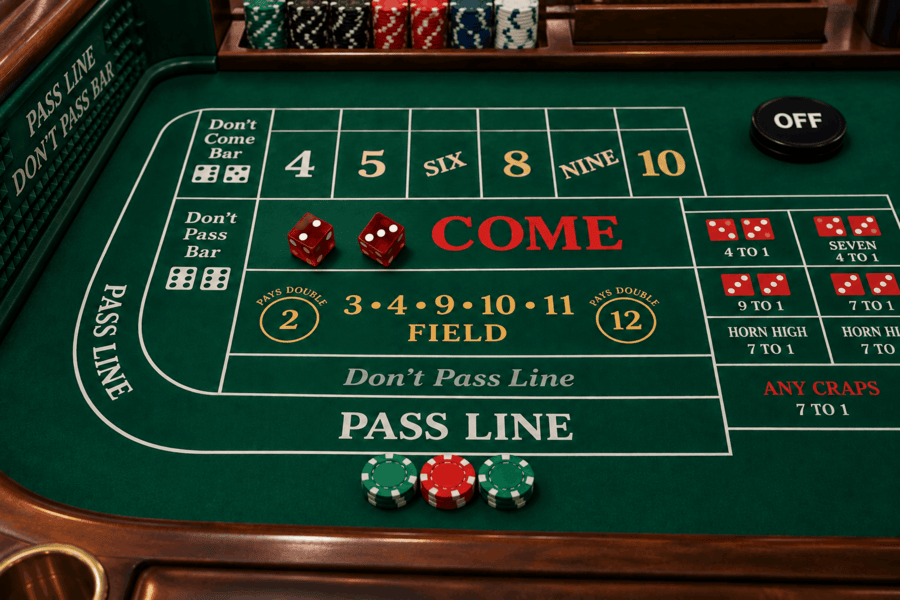
If the come-out roll produces 4, 5, 6, 8, 9 or 10, the number becomes the point. The dealer will usually place a puck marked ON on that number so everyone at the table knows which point is active.
Let’s say the Shooter rolls a 6. Your Pass Line bet is still sitting on the table, but it hasn’t won or lost yet. The aim is now for the Shooter to roll another 6 before rolling a 7.
Well, this is the ‘complicated’ part of craps: the first roll is fairly simple, but from the second roll onward, you need the combined score of the dice to hit the Point to win, and not 7.
4. The Shooter Rolls Again
With the point established, the Shooter keeps rolling. The important thing to remember here is that only two numbers matter for the Pass Line bet at this stage: the point and 7. Other numbers can come up without immediately affecting your Pass Line bet.
For example, if the point is 6, the Shooter could roll 4, 9, 5, 8, 10, or any other number that’s not the Point or 7, and they’ll have to roll again.
If the Shooter eventually rolls another 6, you’ve hit the point, and your Pass Line bet wins. If a 7 comes first, the Pass Line bet loses.
5. How the Round Ends
A Pass Line round can end in one of two ways once a point has been established:
A Pass Line bet can end in only two ways: win or loss. There are no pushes, and if the pass line wins or loses on the come-out roll, the round ends immediately.
If a point is established, the round (including all surrounding bets) ends when the point is made, or a 7 is hit.
Types of Bets in Craps
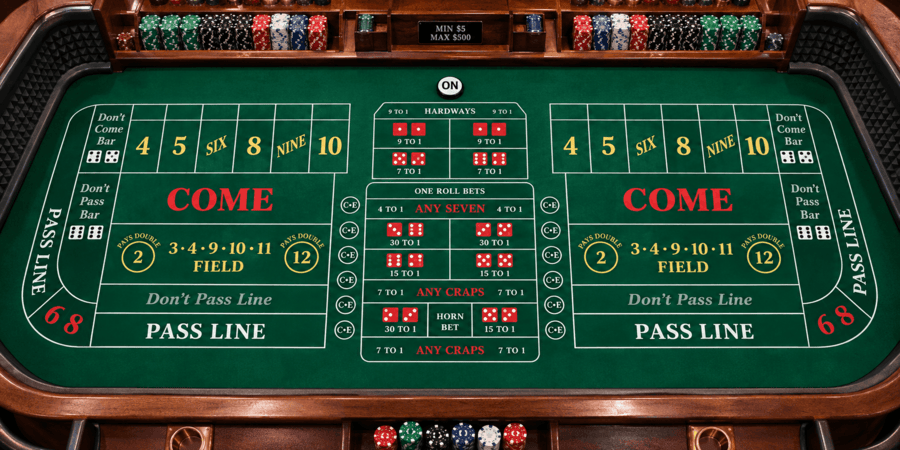
The Pass Line bet I’ve used in the examples above is the most common bet in craps, and it’s the easiest one to learn first. However, as you can see from the table, there are plenty of other betting areas, and they don’t all have the same odds, so craps players often want to spice things up by placing different bets.
Pass Line Bet
The Pass Line is the standard starting point for most craps players. As I’ve covered, you win if the come-out roll is 7 or 11, lose on 2, 3 or 12, and then try to hit the point before a 7 once a point has been established.
On a standard craps table, the Pass Line has a 1.41% house edge, or a theoretical 98.59% RTP. That’s already a relatively low house edge compared with many of the other bets on the table, but it isn’t actually the highest RTP bet available in this game.
Don't Pass Bet
The Don’t Pass is essentially the opposite side of the Pass Line. Instead of hoping the Shooter makes the point, you’re betting against them.
It has a slightly lower house edge of 1.36%, so the theoretical RTP is around 98.64%. The catch is that a Don’t Pass bet pushes if the come-out roll is 12 under standard rules, so it’s not quite as straightforward as simply betting against the Pass Line, but it’s still the mathematically better bet in the long run.
Odds Bets
From a mathematical standpoint, the Odds Bet is the best bet in all casino games. Here’s how it works: once a point has been established, you can place an Odds bet behind your Pass Line bet on the point. Essentially, it’s another bet on the point, but unlike the Pass Line itself, a standard Odds bet has no house edge, meaning its theoretical RTP is 100%.
That’s about as good as casino betting gets, but there is an important catch: you can only make an Odds bet alongside an existing Pass Line or Don’t Pass bet, and casinos usually limit how much you can bet relative to your original wager.
If you’ve ever been at a craps table at the casino, you’ll hear players talking about “taking the odds.” The bet is available in most online craps games too, including live casino games, and if available, I always recommend taking the odds.
Come and Don't Come Bets
The Come and Don’t Come bets work in much the same way as the Pass Line and Don’t Pass, except you can place them after the come-out roll.
A Come bet wins on 7 or 11, loses on 2, 3 or 12, and establishes its own point on 4, 5, 6, 8, 9 or 10. The Don’t Come bet works in the opposite direction.
Both have a 1.41% and 1.36% house edge, respectively, just like their Pass Line counterparts.
Place Bets
With Place bets, you’re betting directly on a number such as 4, 5, 6, 8, 9 or 10 and hoping it appears before a 7.
The RTP varies depending on the number, because some numbers can be achieved through multiple combinations. For example, Place 6 and 8 have a house edge of 1.52%, while Place 5 and 9 are at 4%, and Place 4 and 10 are at 6.67% under standard payouts.
I usually recommend avoiding the Place Bets because they’re completely unnecessary, and you’re better off sticking to the Pass and Don’t Pass line (and the subsequent Odds Bets).
Proposition Bets
Then you have the bets in the middle and around the edge of the table, which may include Any Craps, Hardways, Yo, Horn bets and specific dice combinations.
These are generally much higher-house-edge bets. For example, Any Craps has an 11.11% house edge, while Hard 6 and Hard 8 are at 9.09%, which means it’s best to avoid them altogether.
Alex’s Advice: Craps is available at plenty of Aussie online casinos, although it’s less common than blackjack, roulette or pokies. I’d look for standard craps, stick mainly to Pass Line, Come and Odds bets, and avoid high-house-edge bets such as Any Craps, Any 7 and Horn bets.
5 Things That Will Help You Get Better Odds at Craps
No craps strategy can guarantee a profit, but the bets you choose can make a huge difference in the house edge. Some craps bets have some of the lowest house edges of all casino games, while others are among the worst bets you can make in a casino, so choosing the right bets is especially important in craps.
If you want to keep the house edge as low as possible, these are the things I suggest you look for:
- Choose the Right Craps Game: Look for a standard craps game with fair 1:1 payouts and a reasonable house edge. The house edge is usually written in the rules of the game, and it should be above 98%. Rules can vary between games, so read them carefully before committing money.
- Stick to the Lower-Edge Bets: Pass Line, Don’t Pass, Come and Don’t Come all have a relatively low house edge. These should be your go-to bets if you’re mainly interested in getting the best mathematical odds.
- Take the Odds: Once a point has been established, an Odds bet has no house edge in standard craps. If the casino allows you to take odds, this is one of the best-value bets available, so if your budget allows it, taking the odds is a smart decision.
- Avoid the Side Bets: The big payouts in the centre of the table can be tempting, but bets such as Any Craps, Any 7 and Horn bets come with a much higher house edge, and the odds of winning are laughably low.
- Choose a Reputable Casino: Before you even look at the craps game, make sure the casino is licensed, well-established and has a good reputation. You want to know that you can rely on the operator before putting any money on the craps table.
Latest Articles


Gambling is intended only for adults aged 18 and over. AustralianStakes.com is committed to producing fair, independent content, and our editorial opinions are not shaped by casino operators, advertisers, or other outside parties.
Gambling should always be treated as entertainment and contained within sensible limits. Anyone concerned about their own gambling habits or those of a friend or family member can access confidential support through the following organisations:
- https://responsiblewagering.com.au/
- https://www.gamblinghelponline.org.au/
- https://gamblershelp.com.au/get-help/